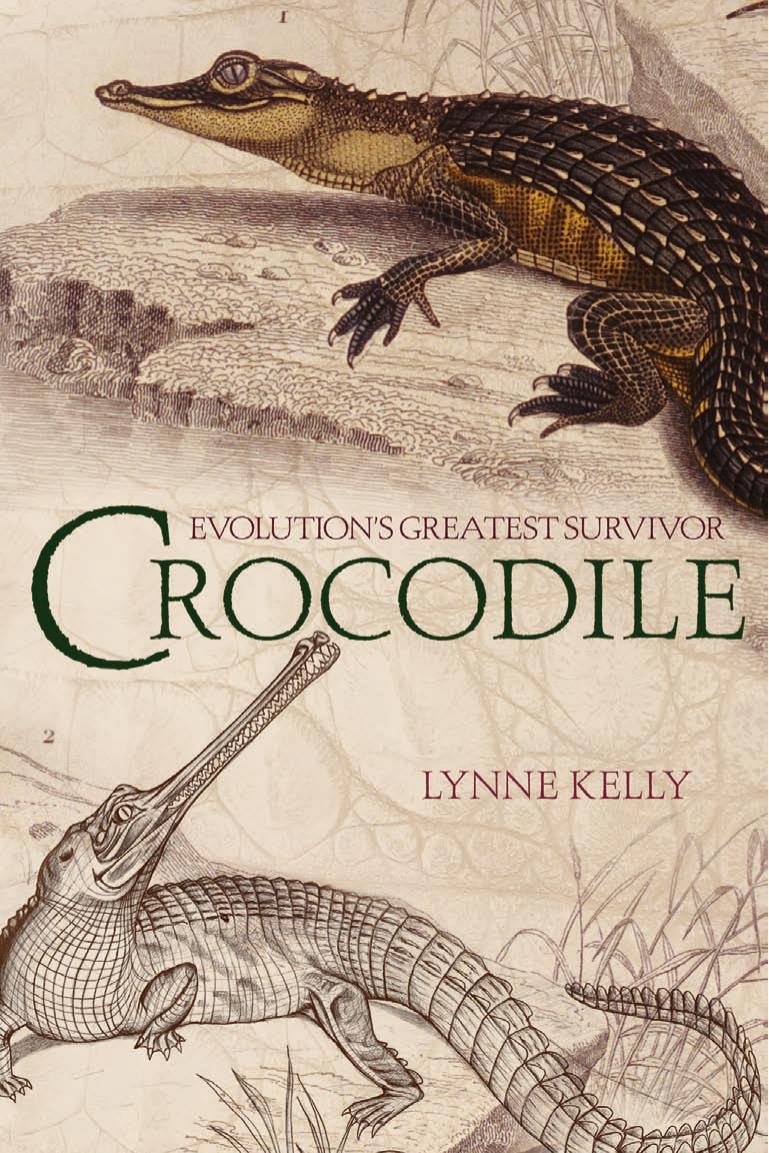
Crocodile by Lynne Kelly
Author:Lynne Kelly
Language: eng
Format: epub, pdf
Tags: NAT028000
ISBN: 9781741761917
Publisher: Allen & Unwin Pty Ltd
Published: 2006-12-01T05:00:00+00:00
*The accepted date prior to the recent discovery of Steve Salisbury’s Isisford crocodilian, said to date back nearly 100 million years before present.
By the end of the Triassic Period the archosaurs had evolved into the dinosaurs and the protoavian pterosaurs. Many of the smaller branches of the crocodilian family tree, such as Huxley’s Stagonolepis, disappeared into extinction. The Jurassic crocodilians included the first branch of the family to take to the water, the thalattosuchians. Many of the Jurassic crocodilians were enormous animals but, by the end of the Cretaceous Period, all had disappeared.
The Cretaceous Period was, truly, the era of the mesosuchians whose fossils have been found in large numbers in Europe, Africa and North America. The Middle Cretaceous saw the rise of a giant crocodilian, Sarchosuchus imperator, a creature now known affectionately as ‘SuperCroc’, while the Late Cretaceous Period saw the emergence of the eusuchians, such as Deinosuchus, and the split in the evolutionary tree that led to the modern families of crocodilians we know today.
There are still many dotted lines to be filled in on the evolutionary family tree, but with a fossil record dating back over 200 million years, the crocodilians have already played a vital role in our understanding of Darwin’s revolutionary theory. Palaeontologists such as Steve Salisbury travel all over the world in search of the evidence that will allow them to block in these dotted lines.
One such travelling scientist is Paul Sereno. In 1997 he left the University of Chicago for the first of a series of expeditions into what is now the sub-Saharan desert in Niger, Africa. In the Middle Cretaceous Period, this arid zone would have teemed with life, swimming in lakes and rivers and foraging through semi-tropical wetlands. Sereno was on the trail of Sarcosuchus imperator, whose teeth and skull had been found thirty years earlier by a French team of palaeontologists. Sereno’s team had barely begun to dig before they found fossils of SuperCroc jaws, each almost 2 metres long. They also found vertebrae, bones and individual scutes that were nearly 30 centimetres long, enough to build a picture of an animal that would have reached almost 12 metres in length and weighed over 17000 kilograms. SuperCroc was so huge that it would have spent most of its time in the water, feeding on the other inhabitants of its lake or lying in wait for unwary small dinosaurs drinking at the water’s edge.
SuperCroc has much to tell us about the ancient crocodilians, not least because of the diversity of crocodilian specimens found alongside him. Sereno’s team found fossils from at least four crocodilian species, including an 8-centimetre long skull of a new species of dwarf crocodile. Although some crocodilians’ territories can overlap, nowhere in the world do we find the same profusion of modern crocodilians in one place. There are still many pieces of the puzzle to put into place, which is why Sereno and other palaeontologists continue to hunt for the fossilised remains of extinct crocodilians. Unfortunately, indiscriminate hunting
Download
This site does not store any files on its server. We only index and link to content provided by other sites. Please contact the content providers to delete copyright contents if any and email us, we'll remove relevant links or contents immediately.
Sapiens: A Brief History of Humankind by Yuval Noah Harari(14376)
The Tidewater Tales by John Barth(12655)
Mastermind: How to Think Like Sherlock Holmes by Maria Konnikova(7330)
Do No Harm Stories of Life, Death and Brain Surgery by Henry Marsh(6940)
The Thirst by Nesbo Jo(6937)
Why We Sleep: Unlocking the Power of Sleep and Dreams by Matthew Walker(6707)
Life 3.0: Being Human in the Age of Artificial Intelligence by Tegmark Max(5551)
Sapiens by Yuval Noah Harari(5367)
The Body: A Guide for Occupants by Bill Bryson(5086)
The Longevity Diet by Valter Longo(5060)
The Rules Do Not Apply by Ariel Levy(4961)
The Immortal Life of Henrietta Lacks by Rebecca Skloot(4581)
Animal Frequency by Melissa Alvarez(4467)
Why We Sleep by Matthew Walker(4436)
The Hacking of the American Mind by Robert H. Lustig(4378)
Yoga Anatomy by Kaminoff Leslie(4359)
All Creatures Great and Small by James Herriot(4314)
Double Down (Diary of a Wimpy Kid Book 11) by Jeff Kinney(4264)
Embedded Programming with Modern C++ Cookbook by Igor Viarheichyk(4175)
